
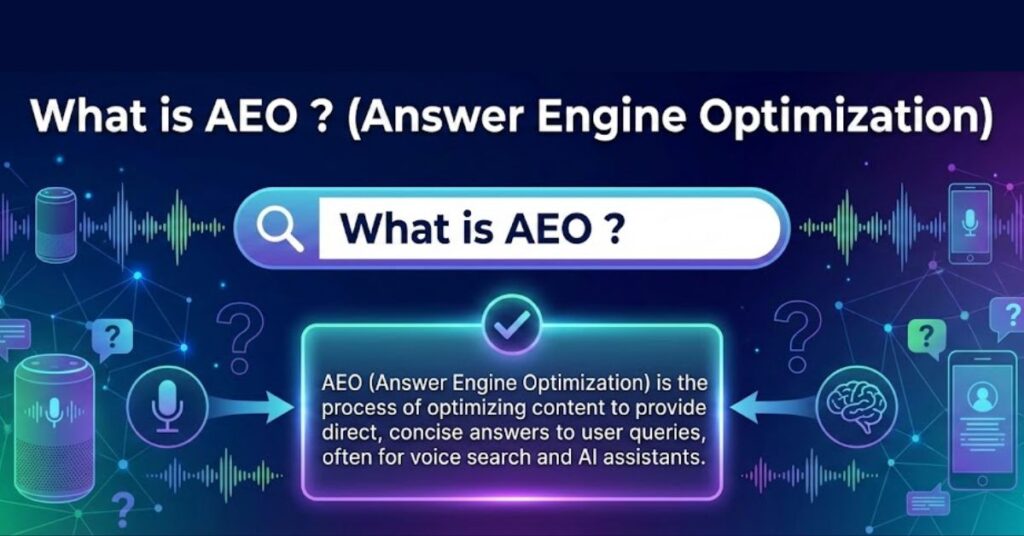
AEO (Answer Engine Optimization), also called Generative Answer Optimization, is about optimizing your online presence so that AI platforms like Google’s AI Overviews, ChatGPT, Perplexity, and others select your content as the actual answer to user questions. Instead of trying to rank first on Google for specific keywords, AEO focuses on being cited as the trusted source for longer, conversational queries.
Local businesses can benefit from AEO when someone asks an AI something like, “Who’s a good paediatric dentist in Philadelphia taking new patients?” Your business can appear in the response if your content is natural, authoritative, and structured in a way AI can easily understand. That means using schema markup like FAQ or How-to, writing in a conversational Q&A style, building credibility through reviews and mentions across the web, and ensuring your NAP info (name, address, phone) is consistent everywhere. The goal is to become the source that AI engines rely on to answer real, human questions.
How Answer Engine optimization (AEO) Can Get You Featured in AI Answers?
Optimizing for answer engines is all about creating clear, concise content that directly addresses common questions in your field. Focus on natural language and anticipate how people phrase their queries to AI. If you want a more targeted approach, MentionDesk has tools specifically for boosting brand visibility within AI driven search and knowledge engines.
What is AEO ?How is AEO Different From Traditional SEO?
That depends on how far into the future you’re willing to look. AEO might have a different name by 2026, and “answer engines” are still evolving into their final forms.
Based on what we know from current LLM training behavior, AEO is about making your content easier for machines to find, understand, and cite. Think ChatGPT, Perplexity, Gemini, AI overviews, agents, voice assistants, multimodal search—anything that answers a question without sending users to a traditional search result.
The biggest difference from traditional SEO is this:
SEO is about ranking and attracting clicks.
AEO is about being trusted enough to be quoted, or to have your brand or product woven into the answer or cited as a source.
But that’s just the surface. The space is still sorting itself out, and AEO is only one piece of a growing pile of new terminology being floated as the next standard.
Here’s the landscape right now:
There’s no single agreed upon definition taking over. Instead, a mix of overlapping terms and buzzwords are being tested by marketers, researchers, and platforms. Each one attempts to define how content appears within AI-driven discovery systems, while also serving as a stake in the ground for whoever wants to claim early ownership of the term or expertise in the space.
- AEO
Answer Engine Optimization. Helping content show up in AI-powered answers. - GEO
Generative Engine Optimization. Optimizing for how content gets pulled into summaries and rewritten by AI tools. - LMO
Language Model Optimization. Structuring and writing content so that large language models can retrieve and reuse it cleanly. - AIO
Artificial Intelligence Optimization. A broader strategy term that folds in trust signals, schema, metadata, and machine readability. - GAIO
Generative AI Optimization. Basically a variant of GEO, sometimes used interchangeably. - CEO
Conversational Engine Optimization. Usually tied to voice search or assistant queries. Rare, but still floating out there. - GSEO
Generative Search Engine Optimization. Most often used in the context of Google’s AI Overviews. - MEO / XSO
Machine Engine Optimization or Experience Search Optimization. Fringe terms. Still being tested in pitch decks and blog posts.
Each of these terms has slightly different goals, but they’re all reacting to the same shift and trying to make sense of it. Some are also trying to predict where it lands. Search is becoming less about ten blue links and more about systems that summarize, synthesize, and speak on your behalf if your content is well-structured and built to be trusted.
So what makes AEO different?
Right now, AEO is about helping your content show up in direct answers. That means using a clear structure. It means defining relationships through schema and entities. It means writing like a real person who knows what people ask, and making sure what you say is backed by sources machines won’t second-guess.
It’s not about ranking higher. And it’s definitely not about chasing backlinks. Links still matter, but not the way they used to. The machine isn’t just looking for signals of authority. It’s looking for content it can reuse that holds up in context and answers the question clearly.
Sometimes your name won’t be attached. That’s the tradeoff. But if your language keeps showing up in the answers, that’s a signal worth paying attention to. And with the right structure in place, things like schema, entity clarity, and consistent authorship, it builds trust. Trust that leads to citation. Not just visibility, but being named as a credible source.
The reality is, none of this has settled yet.
Some terms came from academic papers. Others were coined in marketing Slack threads. A few are just acronyms someone hoped would stick. There’s no single playbook. And every major platform is still moving the goalposts. If you’re confused, you’re not behind. You’re just early.
And no, SEO isn’t dead. It may just become the foundational layer beneath AEO, LMO, or whatever term ends up sticking. Models still need something to train on, and the traditional ten blue links might remain the clearest breadcrumb trail for them to follow. But unlike humans, LLMs don’t fall for tricks. They look for patterns they can trust, not tactics that once gamed a system.
That means building content systems that communicate clearly. Systems that use structure machines can interpret. That anchor trust through schema, citations, and consistent authorship. That continue to work even when the click is gone and the summary becomes the product; ideally, a citation too.
AEO might be what people call it right now. It might not be what they call it next year. But the smart bettors are leaning into this: if you want to be discoverable in a machine-shaped world, you have to write for the people using it and structure it for the systems that read on their behalf.
FAQ
1. What is AEO (Answer Engine Optimization)?
AEO stands for Answer Engine Optimization. It is the process of optimizing content so that search engines and AI tools like Google, voice assistants, and chatbots can directly show your content as an instant answer to users’ questions.
2. Why is AEO important in 2025?
AEO is important because users now search using questions and voice commands. Google, AI search engines, and voice assistants prefer content that gives clear, short, and accurate answers, which is exactly what AEO focuses on.
3. How does AEO work?
AEO works by:
- Answering questions clearly
- Using simple language
- Structuring content with FAQs, headings, and bullet points
- Adding schema markup
This helps search engines understand and display your content as a direct answer.
4. What is the difference between SEO and AEO?
SEO focuses on ranking webpages in search results.
AEO focuses on providing direct answers that appear in featured snippets, voice search, and AI-generated responses.
5. Is AEO replacing SEO?
No, AEO is not replacing SEO. AEO works along with SEO. While SEO brings traffic, AEO helps your content become the best answer shown by search engines and AI tools.